When Does Shades of Blue Start Again 2018
| Bluish | |
|---|---|
 | |
| Wavelength | 440–490 nm |
 Color coordinates Color coordinates | |
| Hex triplet | #0000FF |
| sRGB B (r, g, b) | (0, 0, 255) |
| HSV (h, s, v) | (240°, 100%, 100%) |
| CIELChuv (Fifty, C, h) | (32, 131, 266°) |
| Source | X11 |
| B: Normalized to [0–255] (byte) | |
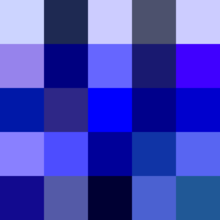
Varieties of the color blue may differ in hue, blush (also called saturation, intensity, or colorfulness), or lightness (or value, tone, or effulgence), or in two or 3 of these qualities. Variations in value are also called tints and shades, a tint being a blue or other hue mixed with white, a shade being mixed with black. A large pick of these colors is shown beneath.
Definitions of blue [edit]
Blueish (RGB) (X11 blue) [edit]
| Blue (Computer web color) | |
|---|---|
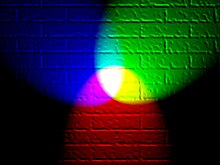 Red, dark-green, and bluish lights, representing the three basic additive primary colors of the RGB color organisation, ruddy, greenish, and blueish | |
| Color coordinates | |
| Hex triplet | #0000FF |
| sRGB B (r, one thousand, b) | (0, 0, 255) |
| HSV (h, s, v) | (240°, 100%, 100%) |
| CIELChuv (50, C, h) | (32, 131, 266°) |
| Source | X11 colour names[ane] HTML/CSS[ii] |
| ISCC–NBS descriptor | Brilliant blue |
| B: Normalized to [0–255] (byte) | |
The color defined equally blue in the RGB color model, X11 blue, is shown at right. This color is the brightest possible blueish that can be reproduced on a computer screen, and is the color named blue in X11. It is one of the 3 principal colors used in the RGB colour space, along with cerise and green. The three additive primaries in the RGB color organisation are the three colors of light chosen such equally to provide the maximum gamut of colors that are capable of being represented on a figurer or television set.
This color is likewise called color wheel blue. It is at 240 degrees on the HSV color wheel, besides known every bit the RGB color bicycle. It is a spectral color which lies at, or almost, the short-wave (violet) end of the traditional "blue" and possibly was classified equally "indigo" past Newton.[3] Its complementary color is yellow.
Blue (CMYK) (pigment blue) [edit]
| Bluish (CMYK) (paint blue) | |
|---|---|
 Cyan, magenta, and yellow are the three subtractive master colors used in printing | |
| Color coordinates | |
| Hex triplet | #333399 |
| sRGB B (r, chiliad, b) | (51, 51, 153) |
| HSV (h, s, v) | (240°, 67%, lx%) |
| CIELChuv (Fifty, C, h) | (28, 73, 266°) |
| Source | CMYK |
| ISCC–NBS descriptor | Vivid blue |
| B: Normalized to [0–255] (byte) | |
The color defined as blue in the CMYK colour system used in printing, likewise known every bit pigment blue, is the tone of blue that is achieved by mixing process (printer'southward) cyan and process (printer's) magenta in equal proportions.
The purpose of the CMYK color system is to provide the maximum possible gamut of colour reproducible in printing by the use of only 3 primaries.
The color indicated is only approximate equally the colors of printing inks may vary.
Bluish (Pantone) [edit]
| Bluish (Pantone) | |
|---|---|
| Color coordinates | |
| Hex triplet | #0018A8 |
| sRGB B (r, g, b) | (0, 24, 168) |
| HSV (h, s, v) | (231°, 100%, 66%) |
| CIELChuv (L, C, h) | (22, 82, 265°) |
| Source | Pantone TPX[4] |
| ISCC–NBS descriptor | Vivid blue |
| B: Normalized to [0–255] (byte) | |
Blueish (Pantone) is the color that is called bluish in Pantone.
The source of this color is the "Pantone Cloth Paper eXtended (TPX)" color list, color # Blue C, EC, HC, M, PC, U, or UP—Bluish.[5]
Blueish (NCS) (psychological primary blue) [edit]
| Blueish (NCS) | |
|---|---|
 Approximations inside the sRGB gamut to the primary colors of the Natural Color System, a model based on the opponent process theory of color vision | |
| Colour coordinates | |
| Hex triplet | #0087BD |
| sRGB B (r, thousand, b) | (0, 135, 189) |
| HSV (h, due south, v) | (197°, 100%, 74%) |
| CIELChuv (L, C, h) | (53, 65, 237°) |
| Source | sRGB approximation to NCS 2060-B [vi] |
| ISCC–NBS descriptor | Moderate blue |
| B: Normalized to [0–255] (byte) | |
The color defined as blueish in the NCS or Natural Color System is an azure-like colour shown at right (NCS 2060-B). The Natural Color System is a colour system based on the iv unique hues or psychological principal colors crimson, xanthous, green, and blueish. The NCS is based on the opponent procedure theory of vision.
The "Natural Color System" is widely used in Scandinavia.
NCS Blue tin only exist displayed approximately on a calculator screen, as these spectral colors have been adjusted to fit into the sRGB gamut. In the 21st century, this hue is classified as an variation of azure that is on the edge of cyan.
Blue (Munsell) [edit]
| Blue (Munsell) | |
|---|---|
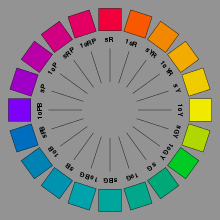 The hues of the Munsell color organization, at varying values, and maximum chroma to stay in the sRGB gamut. | |
| Color coordinates | |
| Hex triplet | #0093AF |
| sRGB B (r, yard, b) | (0, 147, 175) |
| HSV (h, s, v) | (190°, 100%, 69%) |
| CIELChuv (Fifty, C, h) | (56, 52, 220°) |
| Source | Munsell Color Wheel |
| ISCC–NBS descriptor | Potent greenish bluish |
| B: Normalized to [0–255] (byte) | |
The color defined equally blue in the Munsell color arrangement (Munsell 5B) is shown at right. The Munsell color system is a color space that specifies colors based on three color dimensions: hue, value (lightness), and chroma (color purity), spaced uniformly (according to the logarithmic scale which governs man perception) in three dimensions in the Munsell color solid, which is shaped similar an elongated oval at an angle. In guild for all the colors to be spaced uniformly, information technology was found necessary to use a color cycle with five main colors: cherry-red, xanthous, green, blue, and purple.
Munsell tin can simply exist displayed approximately on a computer screen, equally these spectral colors accept been adjusted to fit into the sRGB gamut. In the 21st century, this hue is classified as an intermediate between azure and cyan.
Blue (Crayola) [edit]
| Blue (Crayola) | |
|---|---|
| Color coordinates | |
| Hex triplet | #1F75FE |
| sRGB B (r, grand, b) | (31, 117, 254) |
| HSV (h, south, five) | (217°, 88%, 100%) |
| CIELChuv (L, C, h) | (52, 120, 258°) |
| Source | Crayola |
| ISCC–NBS descriptor | Bright blue |
| B: Normalized to [0–255] (byte) | |
Blue (Crayola) is the color chosen blueish in Crayola crayons.
"Blue" was one of the original Crayola crayons formulated in 1903.
Crayola tin can only exist displayed approximately on a estimator screen. In the 21st century, this hue is classified as an variation of azure that is on the border of blue.
Tints, shades, and variations of blue [edit]
The term tint and shade is used in its technical sense as used in color theory.
In this section, the term 'tint' usually refers to a blueish color mixed with white or light grayness. The term shade is used in its technical sense as used in color theory, meaning a blueish color mixed with black or dark greyness.
The colors arranged in order of their value (brightness) (V in the HSV code), the brighter colors toward the top and the darker colors toward the bottom.
Periwinkle [edit]
| Periwinkle | |
|---|---|
| Color coordinates | |
| Hex triplet | #CCCCFF |
| sRGB B (r, g, b) | (204, 204, 255) |
| HSV (h, southward, v) | (240°, 20%, 100%) |
| CIELChuv (L, C, h) | (84, 42, 266°) |
| Source | Maerz and Paul |
| ISCC–NBS descriptor | Very light purplish blue |
| B: Normalized to [0–255] (byte) | |
Periwinkle (also periwinkle blueish or lavender blue) is a mixture of white, blue, and red. Information technology is named after the Periwinkle flower and is as well commonly referred to equally a tone of lite blueish.

Ultramarine [edit]
| Ultramarine | |
|---|---|
 Ultramarine pigment | |
| Color coordinates | |
| Hex triplet | #4000FF |
| sRGB B (r, yard, b) | (64, 0, 255) |
| HSV (h, s, 5) | (255°, 100%, 100%) |
| CIELChuv (L, C, h) | (35, 133, 268°) |
| Source | [Unsourced] |
| ISCC–NBS descriptor | Vivid blueish |
| B: Normalized to [0–255] (byte) | |

Lapis lazuli, the source of the ultramarine pigment
Ultramarine is a blue paint in use since medieval times. It was originally derived from lapis lazuli, a bright blue mineral.
Medium blue [edit]
| Medium Blueish | |
|---|---|
| Color coordinates | |
| Hex triplet | #0000CD |
| sRGB B (r, k, b) | (0, 0, 205) |
| HSV (h, s, v) | (240°, 100%, eighty%) |
| CIELChuv (L, C, h) | (25, 101, 266°) |
| Source | X11 |
| ISCC–NBS descriptor | Brilliant blue |
| B: Normalized to [0–255] (byte) | |
The web color medium blue is a shade of the standard (h = 240°) blue.
Savoy blue [edit]
| Savoy bluish | |
|---|---|
| Color coordinates | |
| Hex triplet | #4B61D1 |
| sRGB B (r, m, b) | (75, 97, 209) |
| HSV (h, southward, five) | (230°, 64%, 82%) |
| CIELChuv (L, C, h) | (45, 94, 262°) |
| Source | ColorSwatches |
| ISCC–NBS descriptor | Bright bluish |
| B: Normalized to [0–255] (byte) | |
Savoy blue, or savoy azure, is a shade of saturation blue between peacock blueish and periwinkle, lighter than peacock blue.[vii] It owes its proper name to its being the colour of the House of Savoy, a ruling dynasty in Italia from 1861 to 1946.
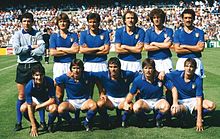
Having go a national color with the unification of Italy (1861), its use continued fifty-fifty after the nativity of the Italian Republic (1946) with the name "Italian blue". An Italian-blue border was inserted on the edge of the Presidential Standard of Italy and the utilise of the bluish scarf for the Italian Armed Forces' officers, for the presidents of the Italian provinces during the official ceremonies and of the blueish jersey for Italian national sports teams it was also maintained in the Republican era.
Freedom [edit]
| Liberty | |
|---|---|
| Colour coordinates | |
| Hex triplet | #545AA7 |
| sRGB B (r, k, b) | (84, 90, 167) |
| HSV (h, southward, v) | (236°, 50%, 65%) |
| CIELChuv (50, C, h) | (41, 64, 264°) |
| Source | ISCC-NBS[8] |
| ISCC–NBS descriptor | Stiff blue |
| B: Normalized to [0–255] (byte) | |
Liberty is a strong blue colour.
The first recorded use of liberty equally a color name in English was in 1918.[9]
Egyptian bluish [edit]
| Egyptian Blue | |
|---|---|
| Color coordinates | |
| Hex triplet | #1034A6 |
| sRGB B (r, g, b) | (xvi, 52, 166) |
| HSV (h, s, v) | (226°, xc%, 65%) |
| CIELChuv (Fifty, C, h) | (28, 82, 263°) |
| Source | webexhibts |
| ISCC–NBS descriptor | Bright blue |
| B: Normalized to [0–255] (byte) | |
Egyptian blue is a pigment that was used in Aboriginal Egypt.
Neon blue [edit]
| Neon Blueish | |
|---|---|
| Color coordinates | |
| Hex triplet | #4D4DFF |
| sRGB B (r, g, b) | (77, 77, 255) |
| HSV (h, due south, five) | (240°, 70%, 100%) |
| CIELChuv (L, C, h) | (44, 131, 266°) |
| Source | Html Css Color |
| ISCC–NBS descriptor | Vivid purplish blue |
| B: Normalized to [0–255] (byte) | |
Neon blue is a vivid purplish blueish.
Nighttime blue [edit]
| Night Blue | |
|---|---|
| Color coordinates | |
| Hex triplet | #00008B |
| sRGB B (r, one thousand, b) | (0, 0, 139) |
| HSV (h, s, v) | (240°, 100%, 55%) |
| CIELChuv (L, C, h) | (15, sixty, 266°) |
| Source | X11 |
| ISCC–NBS descriptor | Vivid blue |
| B: Normalized to [0–255] (byte) | |
Dark blueish is a shade of the standard (h = 240°) bluish.
Picotee blue [edit]
| Picotee Blue | |
|---|---|
| Color coordinates | |
| Hex triplet | #2E2787 |
| sRGB B (r, thou, b) | (46, 39, 135) |
| HSV (h, s, v) | (244°, 71%, 53%) |
| CIELChuv (50, C, h) | (23, 63, 267°) |
| Source | ColorSwatches |
| B: Normalized to [0–255] (byte) | |
Picotee blue represents the color of the picotee bloom. It is a deep shade of indigo, nearly resembling St. Patrick's Blue.
[edit]
| Navy Blue | |
|---|---|
| Color coordinates | |
| Hex triplet | #000080 |
| sRGB B (r, grand, b) | (0, 0, 128) |
| HSV (h, s, 5) | (240°, 100%, 50%) |
| CIELChuv (L, C, h) | (13, 52, 266°) |
| Source | HTML/CSS[2] |
| ISCC–NBS descriptor | Vivid blueish |
| B: Normalized to [0–255] (byte) | |

Navy blue is a shade of the standard (h = 240°) blue. Navy blueish got its proper noun from the dark blue (assorted with white) worn by sailors in the Majestic Navy since 1748 (originally called marine bluish before 1840) and later adopted past other navies around the earth.
The offset recorded use of navy blue equally a color name in English was in 1840.[10]
Midnight blue [edit]
| Midnight Blue | |
|---|---|
| Color coordinates | |
| Hex triplet | #191970 |
| sRGB B (r, 1000, b) | (25, 25, 112) |
| HSV (h, due south, v) | (240°, 78%, 44%) |
| CIELChuv (L, C, h) | (16, 49, 266°) |
| Source | X11 |
| ISCC–NBS descriptor | Vivid blueish |
| B: Normalized to [0–255] (byte) | |
Midnight blueish is an X11 web color. This colour was originally chosen midnight. The first recorded apply of midnight as a colour name in English was in 1915.[11]
Independence [edit]
| Independence | |
|---|---|
| Colour coordinates | |
| Hex triplet | #4C516D |
| sRGB B (r, g, b) | (76, 81, 109) |
| HSV (h, s, five) | (231°, 30%, 43%) |
| CIELChuv (L, C, h) | (35, 23, 260°) |
| Source | ISCC-NBS |
| ISCC–NBS descriptor | Dark blue |
| B: Normalized to [0–255] (byte) | |
Independence is a nighttime blueish color.
The showtime recorded use of independence as a color proper name in English was in 1927.[12]
Space cadet [edit]
| Space Buck | |
|---|---|
| Color coordinates | |
| Hex triplet | #1E2952 |
| sRGB B (r, g, b) | (thirty, 41, 82) |
| HSV (h, south, v) | (227°, 63%, 32%) |
| CIELChuv (Fifty, C, h) | (18, 29, 260°) |
| Source | Resene |
| ISCC–NBS descriptor | Dark blueish |
| B: Normalized to [0–255] (byte) | |
Space cadet is 1 of the colors on the Resene Color List, a color listing popular in Australia and New Zealand. The colour "space cadet" was formulated in 2007.
International Klein Blue [edit]
| International Klein Blue | |
|---|---|
 International Klein Blue pigment | |
| Color coordinates | |
| Hex triplet | #120A8F |
| sRGB B (r, thousand, b) | (18, ten, 143) |
| HSV (h, s, v) | (244°, 93%, 56%) |
| CIELChuv (L, C, h) | (17, 65, 266°) |
| Source | [13] |
| ISCC–NBS descriptor | Vivid blue |
| B: Normalized to [0–255] (byte) | |
International Klein Blue (IKB) is a deep blue hue outset mixed by the French creative person Yves Klein. IKB's visual impact comes from its heavy reliance on ultramarine, likewise as Klein's oft thick and textured application of pigment to canvas. In that location is a legend that Klein patented the color, but in reality he only submitted a Soleau envelope and never progressed to the patent phase.
Blurple (2015-2021) [edit]
| Original Blurple | |
|---|---|
| Colour coordinates | |
| Hex triplet | #7289da |
| sRGB B (r, g, b) | (114, 137, 218) |
| HSV (h, southward, v) | (227°, 48%, 85%) |
| CIELChuv (Fifty, C, h) | (59, 72, 259°) |
| Source | [fourteen] |
| ISCC–NBS descriptor | Brilliant purplish blueish |
| B: Normalized to [0–255] (byte) | |
Original Blurple is a brilliant purplish blue hue. It is the older version of Blurple, described to a higher place. It was used in the old Discord logo. Earlier 13 May 2021, it was simply chosen Blurple.[fifteen]
Blurple (2021-Nowadays) [edit]
| Blurple | |
|---|---|
 Blurple-colored bluebellvine | |
| Color coordinates | |
| Hex triplet | #5865f2 |
| sRGB B (r, k, b) | (88, 101, 242) |
| HSV (h, s, v) | (235°, 64%, 95%) |
| CIELChuv (L, C, h) | (49, 114, 264°) |
| Source | [16] |
| ISCC–NBS descriptor | Vivid purplish blue |
| B: Normalized to [0–255] (byte) | |
Blurple is a vivid purplish blue hue. It is used in the new Discord logo.[xv]
Cool blackness [edit]
| Cool blackness (PMS 295) | |
|---|---|
| Color coordinates | |
| Hex triplet | #002E63 |
| sRGB B (r, 1000, b) | (0, 46, 99) |
| HSV (h, s, five) | (212°, 100%, 39%) |
| CIELChuv (Fifty, C, h) | (xix, 41, 255°) |
| Source | [Unsourced] |
| ISCC–NBS descriptor | Very dark bluish |
| B: Normalized to [0–255] (byte) | |
Cool black is a dark shade of blueish. It is 1 of Pantone colors.[17]
Ambiguous variations of blue [edit]
In this section, shades fall outside the tertiary color range for blue, and many tin can be considered variations of cyan and azure, rather than bluish.
Baby blue [edit]
| Baby blue | |
|---|---|
| Color coordinates | |
| Hex triplet | #89CFF0 |
| sRGB B (r, g, b) | (137, 207, 240) |
| HSV (h, s, v) | (199°, 43%, 94%) |
| CIELChuv (Fifty, C, h) | (80, 48, 227°) |
| Source | Maerz and Paul[18] |
| ISCC–NBS descriptor | Very lite greenish blue |
| B: Normalized to [0–255] (byte) | |
Baby blueish is known as ane of the pastel colors.
The kickoff recorded use of baby blue every bit a color name in English was in 1892.[nineteen]
Light blue [edit]
| Light blue | |
|---|---|
| Color coordinates | |
| Hex triplet | #ADD8E6 |
| sRGB B (r, thou, b) | (173, 216, 230) |
| HSV (h, s, 5) | (195°, 25%, 90%) |
| CIELChuv (Fifty, C, h) | (84, 28, 216°) |
| Source | X11 |
| ISCC–NBS descriptor | Very calorie-free greenish blueish |
| B: Normalized to [0–255] (byte) | |
The web colour low-cal blue is part of the X11 color system, with a hue code of 194. Variations of this colour are known as sky blue, baby blue, or angel blue.
The first recorded use of "light blue" as a colour term in English is in 1915.[20]
Pulverisation blue [edit]
| Pulverisation Blueish | |
|---|---|
| Color coordinates | |
| Hex triplet | #B0E0E6 |
| sRGB B (r, g, b) | (176, 224, 230) |
| HSV (h, s, v) | (187°, 23%, ninety%) |
| CIELChuv (L, C, h) | (86, 26, 202°) |
| Source | X11[2] |
| ISCC–NBS descriptor | Very light bluish greenish |
| B: Normalized to [0–255] (byte) | |
Powder blue is a light bluish light-green.
The outset recorded use of powder blue as a color proper noun in English language was in 1774.[21] Information technology is a web color.
Uranian bluish [edit]
| Uranian Blueish | |
|---|---|
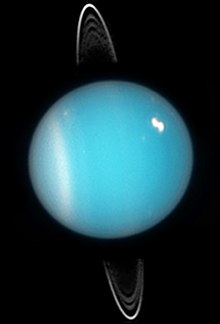 Uranus with clouds | |
| Color coordinates | |
| Hex triplet | #AFDBF5 |
| sRGB B (r, one thousand, b) | (175, 219, 245) |
| HSV (h, s, v) | (202°, 29%, 96%) |
| CIELChuv (L, C, h) | (85, 35, 229°) |
| Source | Colour-Hex |
| ISCC–NBS descriptor | Very calorie-free greenish blueish |
| B: Normalized to [0–255] (byte) | |
Uranian blue is a calorie-free light-green blue, the color of Uranus.
Argentinian bluish [edit]
| Argentinian Blue | |
|---|---|
 Flag of Argentina | |
| Colour coordinates | |
| Hex triplet | #6CB4EE |
| sRGB B (r, k, b) | (108, 180, 238) |
| HSV (h, s, v) | (207°, 55%, 93%) |
| CIELChuv (L, C, h) | (71, 65, 241°) |
| Source | [Unsourced] |
| ISCC–NBS descriptor | Light blue |
| B: Normalized to [0–255] (byte) | |
The web color Argentinian blueish is a lite azure color seen on the national flag of Argentina.
Ruby-red blue [edit]
| Scarlet Bluish | |
|---|---|
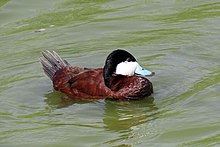 Cherry-red duck (male person) | |
| Color coordinates | |
| Hex triplet | #76ABDF |
| sRGB B (r, m, b) | (118, 171, 223) |
| HSV (h, southward, v) | (210°, 47%, 87%) |
| CIELChuv (L, C, h) | (68, 56, 243°) |
| Source | ColorSwatches |
| ISCC–NBS descriptor | Brilliant blue |
| B: Normalized to [0–255] (byte) | |
Reddish blue represents the coloring of the beak of the ruddy duck.
Celtic bluish [edit]
| Celtic Blue | |
|---|---|
| Color coordinates | |
| Hex triplet | #246BCE |
| sRGB B (r, 1000, b) | (36, 107, 206) |
| HSV (h, due south, v) | (215°, 83%, 81%) |
| CIELChuv (L, C, h) | (46, 91, 255°) |
| Source | Encycolorpedia |
| ISCC–NBS descriptor | Brilliant blue |
| B: Normalized to [0–255] (byte) | |
Celtic blueish is a shade of blue, too known as glas celtig in Welsh, or gorm ceilteach in both the Irish linguistic communication and in Scottish Gaelic. Julius Caesar reported (in Commentarii de Bello Gallico) that the Britanni used to colour their bodies blue with vitrum, a discussion that means primarily "glass", but also the domestic name for the "woad" (Isatis tinctoria), besides the Gaulish loanword glastum (from Proto-Celtic *glastos "green"). The connection seems to be that both glass and the woad are "water-similar" (lat. vitrum is from Proto-Indo-European *wed-ro- "h2o-like").
Spanish blue [edit]
| Castilian Bluish | |
|---|---|
| Color coordinates | |
| Hex triplet | #0070BB |
| sRGB B (r, chiliad, b) | (0, 112, 187) |
| HSV (h, southward, v) | (204°, 100%, 73%) |
| CIELChuv (L, C, h) | (46, 76, 249°) |
| Source | Gallego and Sanz[22] |
| ISCC–NBS descriptor | Stiff blue |
| B: Normalized to [0–255] (byte) | |
Spanish bluish is the color that is chosen Azul (the Castilian give-and-take for "blueish") in the Guía de coloraciones (Guide to colorations) by Rosa Gallego and Juan Carlos Sanz, a color dictionary published in 2005 that is widely pop in the Hispanophone realm.
Bleu de France [edit]
| Bleu de French republic | |
|---|---|
| Color coordinates | |
| Hex triplet | #318CE7 |
| sRGB B (r, yard, b) | (49, 140, 231) |
| HSV (h, s, five) | (210°, 79%, 91%) |
| CIELChuv (50, C, h) | (57, 90, 250°) |
| Source | Pourpre.com |
| ISCC–NBS descriptor | Vivid blue |
| B: Normalized to [0–255] (byte) | |
Bleu de France is a vivid blue colour that has been associated in heraldry with the Kings of France since the 12th century.
Delft blue [edit]
| Delft Blueish | |
|---|---|
| Colour coordinates | |
| Hex triplet | #1F305E |
| sRGB B (r, g, b) | (31, 48, 94) |
| HSV (h, s, v) | (224°, 67%, 37%) |
| CIELChuv (Fifty, C, h) | (21, 35, 258°) |
| Source | [ane]Derwent |
| ISCC–NBS descriptor | Dark blue |
| B: Normalized to [0–255] (byte) | |
Delft blue is a dark blueish color.
The proper noun is derived from the Dutch pottery Delftware, likewise known only every bit "Delft Blue".
Duck bluish [edit]
| Duck Blue | |
|---|---|
| Color coordinates | |
| Hex triplet | #007791 |
| sRGB B (r, g, b) | (0, 119, 145) |
| HSV (h, southward, v) | (191°, 100%, 57%) |
| CIELChuv (50, C, h) | (46, 44, 222°) |
| Source | ISCC-NBS |
| ISCC–NBS descriptor | Moderate greenish bluish |
| B: Normalized to [0–255] (byte) | |
Duck blue is a moderate greenish blue.
Resolution blue [edit]
| Resolution Blue | |
|---|---|
| Color coordinates | |
| Hex triplet | #002387 |
| sRGB B (r, one thousand, b) | (0, 35, 135) |
| HSV (h, s, five) | (224°, 100%, 53%) |
| CIELChuv (50, C, h) | (twenty, 64, 263°) |
| Source | Xona.com Color List |
| ISCC–NBS descriptor | Vivid blue |
| B: Normalized to [0–255] (byte) | |
Resolution blue is a vivid blue color.
This color name first came into use in 2001 when it was formulated every bit one of the colors on the Xona.com Color List.
Polynesian blue [edit]
| Polynesian Blue | |
|---|---|
| Colour coordinates | |
| Hex triplet | #224C98 |
| sRGB B (r, g, b) | (34, 76, 152) |
| HSV (h, due south, 5) | (219°, 78%, 60%) |
| CIELChuv (L, C, h) | (34, 66, 257°) |
| Source | ColorSwatches |
| ISCC–NBS descriptor | Vivid blue |
| B: Normalized to [0–255] (byte) | |
Polynesian blue is a nighttime blueish color, most navy.
Moroccan Blueish [edit]
| Chefchaouen Blueish | |
|---|---|
| Color coordinates | |
| Hex triplet | #468fea |
| sRGB B (r, thousand, b) | (70, 143, 234) |
| HSV (h, s, v) | (213°, 70%, 92%) |
| CIELChuv (L, C, h) | (59, 89, 252°) |
| Source | Color-Hex |
| ISCC–NBS descriptor | Bright blue |
| B: Normalized to [0–255] (byte) | |
Moroccan bluish (also Chefchaouen blue) is a vivid blue color.
Sapphire [edit]
| Sapphire | |
|---|---|
 Sapphire gemstone | |
| Color coordinates | |
| Hex triplet | #082567 |
| sRGB B (r, k, b) | (8, 37, 103) |
| HSV (h, southward, 5) | (222°, 92%, twoscore%) |
| CIELChuv (50, C, h) | (17, 45, 260°) |
| Source | 99Colors |
| ISCC–NBS descriptor | Deep blue |
| B: Normalized to [0–255] (byte) | |
Sapphire is a deep shade of navy bluish, based on the color of an boilerplate sapphire gemstone. Notwithstanding, sapphires can also be pink, yellow, or orange.
Fluorescent blue [edit]
| Fluorescent bluish | |
|---|---|
 Indian 50 rupee note, obverse | |
| Color coordinates | |
| Hex triplet | #15F4EE |
| sRGB B (r, chiliad, b) | (21, 244, 238) |
| HSV (h, south, v) | (178°, 91%, 96%) |
| CIELChuv (L, C, h) | (87, 68, 188°) |
| Source | [Unsourced] |
| ISCC–NBS descriptor | Vivid bluish green |
| B: Normalized to [0–255] (byte) | |
Fluorescent blueish is a shade of blue that is radiant based on fluorescence. This is the main color on the Indian l-rupee note.
Yale Blue [edit]
| Yale "Blue Site" Blue | |
|---|---|
| Colour coordinates | |
| Hex triplet | #00356B |
| sRGB B (r, g, b) | (0, 53, 107) |
| HSV (h, s, v) | (210°, 100%, 42%) |
| CIELChuv (L, C, h) | (22, 45, 254°) |
| Source | Identity Guidelines |
| ISCC–NBS descriptor | Deep bluish |
| B: Normalized to [0–255] (byte) | |
Yale Bluish is the dark azure color used in association with Yale University. The hue of Yale Blue is one of the two official colors of Indiana State University,[23] the University of Mississippi,[24] and Southern Methodist University.[25] The official colour "DCU Blue" of Dublin City University is very shut to Yale Blue.[26]
Yale Blue was also an official color of University of California, Berkeley[27] and Duke Academy.[28]
Teal blue [edit]
| Teal blue | |
|---|---|
| Color coordinates | |
| Hex triplet | #367588 |
| sRGB B (r, g, b) | (54, 117, 136) |
| HSV (h, s, v) | (194°, threescore%, 53%) |
| CIELChuv (L, C, h) | (46, 34, 220°) |
| Source | Kelly, Kenneth L. and Judd, Deanne B. (December 1976) "Color: Universal Language and Lexicon of Names", National Agency of Standards, Spec. Publ. 440 |
| ISCC–NBS descriptor | Moderate greenish blue |
| B: Normalized to [0–255] (byte) | |
Teal blue is a medium tone of teal with more blueish.
The showtime recorded use of teal blue as a colour name in English was in 1927.[29]
See also [edit]
- Lists of colors
- Azure (color)
- Cyan
References [edit]
- ^ "X11 rgb.txt". Archived from the original on 2015-11-07. Retrieved 2008-02-05 .
- ^ a b c "W3C TR CSS3 Color Module, HTML4 color keywords". W3C. May 2003. Retrieved 2008-02-05 .
- ^ Waldman, Gary (2002). Introduction to low-cal : the physics of light, vision, and colour (Dover ed.). Mineola: Dover Publications. p. 193. ISBN978-0-486-42118-half dozen.
- ^ Type the word "Blue" into the indicated window on the Pantone Color Finder and the colour will announced. There are seven versions, all with the same color codes—C, EC, HC, Chiliad, PC, U, and UP.
- ^ Pantone TPX Pantone Color Finder--Blazon the word "Bluish" into the indicated window on the Pantone Color Finder and the color will appear. There are vii versions, all with the aforementioned color codes—C, EC, HC, M, PC, U, and Up.:
- ^ The sRGB values are taken by converting the NCS colour 2060-B using the "NCS Navigator" tool at the NCS website.
- ^ Grossmann 1911. sfn mistake: no target: CITEREFGrossmann1911 (assistance)
- ^ Colour sample #196 on the ISCC-NBS color list is the color sample that matches the color in the book by Maerz and Paul A Lexicon of Colour New York:1930 McGraw-Loma--Colour Sample of Liberty: Page 109 Plate 43 Colour Sample C12
- ^ Maerz and Paul A Lexicon of Color New York:1930 McGraw-Hill Page 197; Colour Sample of Liberty: Page 109 Plate 43 Color Sample C12
- ^ Maerz and Paul A Lexicon of Colour New York:1930 McGraw-Hill Folio 103; Color Sample of Navy blue: Folio 131 Plate 40 Color Sample E11
- ^ Maerz and Paul A Dictionary of Colour New York: 1930 McGraw-Hill Page 199; Color Sample of Midnight: Page 103 Plate 40 Colour Sample A8
- ^ Maerz and Paul A Lexicon of Colour New York:1930 McGraw-Hill Page 196; colour sample of Independence: Folio 117 Plate 47 Color Sample H12
- ^ "Ultramarine / #120a8f hex color".
- ^ "#7289da hex color".
- ^ a b Nelly (xiii May 2021). "Happy Blurpthday to Discord, a Place for Everything Y'all Can Imagine". Discord Blog . Retrieved 13 May 2021.
- ^ "#5865f2 hex color".
- ^ "PANTONE 295 C". Pantone. Pantone. Retrieved 2021-12-04 .
- ^ The color displayed in this colour box matches the colour called baby blue in the 1930 volume by Maerz and Paul A Lexicon of Colour New York:1930 McGraw-Hill; the colour infant blue is displayed on page 93, Plate 35, Color Sample E2.
- ^ Maerz and Paul A Lexicon of Color New York:1930 McGraw-Loma Folio 190; Color Sample of Baby Blue: Page 93 Plate 35 Color Sample E2
- ^ Maerz and Paul A Dictionary of Color New York:1930 McGraw-Hill Page 190
- ^ Maerz and Paul A Dictionary of Colour New York:1930 McGraw-Hill Page 202. Run across color sample of pulverization blue, Folio 95--Plate 36 Colour Sample H2
- ^ Gallego, Rosa; Sanz, Juan Carlos (2005). Guía de coloraciones (Gallego, Rosa; Sanz, Juan Carlos (2005). Guide to Colorations) Madrid: H. Blume. ISBN 84-89840-31-8
- ^ "About - Indiana State Academy".
- ^ "Ole Miss Traditions: Cherry-red & Blue". Academy of Mississippi. October 1, 2002. Retrieved January 4, 2012.
- ^ "SMU SPIRIT AND TRADITIONS". Southern Methodist University. Retrieved January four, 2012.
- ^ "Public Affairs and Media Relations Part - corporate identity - DCU identity - DCU".
- ^ "History, Symbols, and Traditions: What are Cal'south official colors?". Academy of California, Berkeley. May 8, 2007. Retrieved December iii, 2007.
- ^ "The origin of Duke Bluish". Knuckles Academy Libraries. Retrieved December 3, 2007.
- ^ Maerz, Aloys John and M. Rea Paul (1930) A Dictionary of Color, New York, McGraw-Loma, p. 205; colour sample of Teal Bluish: p. 101 Plate 39 Color Sample L6
Source: https://en.wikipedia.org/wiki/Shades_of_blue
0 Response to "When Does Shades of Blue Start Again 2018"
Post a Comment