Midlife crisis in women: What are the signs and how to cope with it
How many times have you seen a centre-aged human being in his 50s in a flashy sports motorcar and idea, "Ack. Midlife crunch"?
While midlife is divers by an age range of 45 to 65 years, midlife crises can occur before than 45 and terminal well across 65 years.
The term was first coined by a Canadian psychoanalyst Elliot Jaques in a 1965 paper and described one'south realisation of restricted possibilities, limitations and mortality.
Dr Adaline Ng, a senior principal clinical psychologist with Meliorate Life, defines today's midlife crunch as when one feels that the life they have been leading is misaligned with the core of their identity.
This leads to feeling concerned nigh making a personal mark in the earth. The feeling of a crisis worsens with the perception that time is finite to go there.
Maybe you lot've met a eye-aged woman who has radically inverse her looks or style or started yoga or attends spin class. Or you may know of a neighbor who has decided to make a huge life modify and dedicate her life to travelling or social causes. These could be how midlife crisis presents itself in women.
A friend of mine, Yasmeen, 53, a project manager, felt so disconnected from her life and family that she recently confided, "I feel like making a major motility and migrating. I feel stifled and my torso no longer works the same way. Information technology'due south excruciating to see projects go to younger colleagues and worse, my teenagers are not spending time with me anymore. I don't see the point – what's left for me here? Is this a midlife crunch?"
This conflict between personal perception of themselves can bring some symptoms of midlife crisis to the fore. Chief psychologist Jolene Hwee and founder of Clarity Counselling, says these are non exhaustive only are defined as:
- Feeling unfulfilled in life
- Intense feelings of nostalgia
- Persistent feelings of emptiness and a general sense of feeling meaningless
- Dramatic changes in behaviour and appearance
- Intense feeling of regret
- Constant comparison of oneself to others who seem more content or fulfilled.
NOT TAKING AGEING WELL AT 49
Sarah Lim, 49, saw the writing on the wall when her hairstylist started cutting her hair differently. "Instead of the usual cut, I got something more than conservative. On height of that, I lost my once-perfect eyesight to long-sightedness."
For Lim, the emotional bleed wasn't relationships or existential but instead, that her physical changes were not lining upwardly with her own expectations of ageing gracefully.
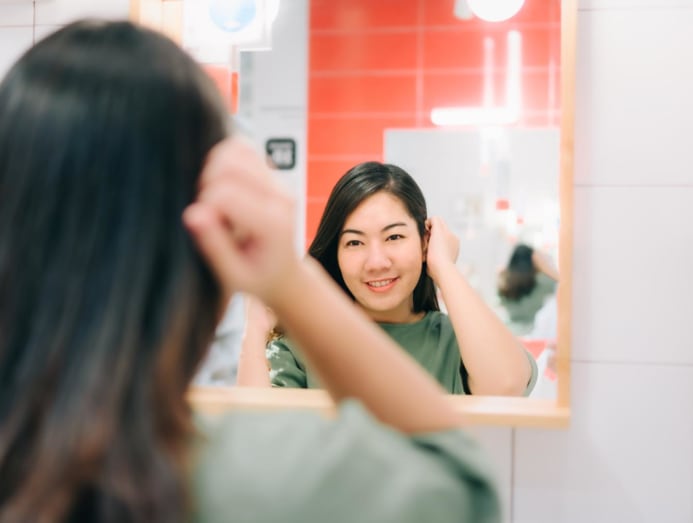
The banking executive said: "One twenty-four hours, you lot wake up and all of a sudden your face looks dissimilar. When I fly next, my eyebags would require me to pay for excess luggage. This change in trunk shape was a rude awakening too – flabby arms and dorsum fat."
She felt alone and unable to discuss these changes as they would be viewed as "superficial or shallow" especially compared to hardships near of the world were suffering due to COVID-nineteen.
Instead, she reflected on her emotions and came to terms with the fact that she merely wasn't accepting her midlife. "I researched on what I could become done to transition improve into my golden years."
Lim started seeing a dermatologist for her skin and has had some aesthetics treatments washed. She besides picked upwardly gym grooming, goes for runs and signed up for spin classes to keep fit.
The mother of three teenagers admits that it was personal conclusion that helped her accept this stage in her life and take active steps to adapt to it. "These changes – they are part of ageing, and you can't end that. But you can shift your perspective and arrive easier to accept."
HOW WOMEN EXPERIENCE MIDLIFE
Societal expectations of gender roles draw vastly different experiences for men and women in midlife.
For men, who are traditionally more career-focused, this life stage provides some other avenue to leave a mark in the earth within what's left of their prime years. And then, they may find ways to cope in a more than outward manner, such as ownership a flashy car or irresolute their advent to relive their younger days.
For women, this is a time of many adjustments. Research on midlife crises focused on women has found that they faced multiple challenges socially, psychologically, and biologically during their middle-age years.
Physically, they are experiencing change in their bodies with menopause. They are also transitioning age-wise and similar men, considering their life choices and legacies.
It is this fourth dimension, equally part of cocky-discovery biologically, that a woman may tune in to herself, and find that her own needs take non been fulfilled. Some of the reflections include changing family relationships, rebalancing work and personal life fulfilment.
Compounded with life changes such as loss either past divorce, death of a partner or loved ones, children growing up, becoming independent and relying on them less, women in midlife may find themselves at a loss.
"These women had express bandwidth to nourish to themselves when their children were minor. Now, this sense of identity, earlier entwined with maternity, becomes open to interpretation and they feel lost nigh who they are," said Dr Ng.
Midlife crunch does not only happen to those married with kids. In fact, for women who exercise not have children, their midlife concerns could be centred on creating something that represents their personal legacy.
Dr Ng added: "This may arise in women who experience that the lives they've led thus far, do not accept a significant impact in their earth."
In 2019, researchers, using data from the Seattle Midlife Women's Health Study, a longitudinal report spanning 23 years,identified multiple stressors in women which may happen simultaneously, such as divorce or a breakdown, wellness problems, last disease or even expiry of their parents, with their children becoming more than independent, causing them to experience a sense of emptiness .
Another clinical paper, which also took data from the Seattle study, constitute that women considered things like financial security, health, family and close friends equally major factors in determining their midlife crisis.
These events, coupled with the societal expectations of women'due south roles, as indicated by their family unit, friends and even the workplace, created the impact of stress which fabricated up the "crisis".
This isn't what I signed up for. Or, I am unhappy or unfulfilled with my life. Why take I worked so hard and still have debt or own null I can phone call my own?
The written report found that women noted changes in their midlife, such as their eating habits, recreation and sleeping habits. They besides described suffering a major illness or injury which had triggered stress factors.
These triggers inadvertently cause women to rethink their life situation. And the procedure unearthed a feeling of cocky-actualisation, compounded by cultural expectations or learned experiences. All these lead to a feeling of flux.
THE FEELING OF FLUX
This flux is described by writer Ada Calhoun, writer of Why We Tin't Sleep: Women's New Midlife Crunch.
Women in midlife today, born in the late 1960s through the 1970s, are Generation X. The same generation faced many significant historical events: The booms of the 80s and 90s, the dot.com burst, 9/11 and having to transition through their life with technology, and now, with the internet and social media.

These Gen Xers were told they could "accept it all" by balancing piece of work and home.
"The context for Gen X women is this: We were an experiment in crafting a higher-achieving, more fulfilled, more well-rounded version of the American woman. In midlife, many of united states observe that the experiment is largely a failure," Calhoun said in the book.
Although written through her conversations with American women, the thread seems to be the aforementioned: This isn't what I signed up for. Or, I am unhappy or unfulfilled with my life. Why have I worked and then difficult and still accept debt or own aught I tin can telephone call my own?
The crunch is not specific to American women – it happens to women everywhere. And information technology has been fabricated worse by the pandemic.
Of a sudden AT A LOSS AT l
The pandemic and Singapore's circuit breaker in 2022 brought Irene Chan's feeling of transition to midlife to the fore. "My kids left for university overseas one after another and I was faced with an empty nest and only my husband every twenty-four hours."

Information technology was then that the 50-year-old realised she couldn't carry to think of the futurity with him and although she loved him, she didn't bask his visitor.
"Apart from the kids, we didn't accept much in common anymore. We don't agree on many issues and it was frustrating and upsetting to accept conversations. The realisation of this after more than twenty years together, shocked me to the core. I suffered from low, insomnia and constant fatigue," she said.
Desperation collection her to come across a psychologist and the couple also saw a union counsellor "but it became clear to me that I needed to leave the relationship".
That sparked a series of changes for Chan – she plant a new chore, took on new hobbies similar Zumba, hiking and even doing volunteer work and so that she could work on her own self-image. She wanted to find her independence through her "new" lifestyle and felt that she needed to succeed personally, at the cost of everything.

With the help of her psychologist, she learnt to recognise her stress triggers and be selective with words during difficult conversations. "I no longer take an unhealthy co-dependent relationship with my husband. I make my own decisions and for in one case, I have freedom and independence which I accept non felt since I was married. I am hoping this new person volition be able to notice peace with my family."
WHAT Yous Can Practise
There is no single solution to a woman facing midlife crunch. Experts say information technology is a procedure of rediscovery and finding out what works best but non to do it alone.
Hwee of Clarity Counselling said: "If you find yourself burnt-out, self-doubting, constantly exhausted or feeling like you've failed, it may be helpful to reflect and explore what is meaningful to you in this season of your life.
"Information technology is an opportunity to re-evaluate your life and focus on what truly matters. Have your time to make pocket-sized, intentional and impactful modify."
She added that sometimes these feelings may be compounded with the onset of menopause, creating hormonal symptoms similar hot flashes, abrupt mood swings which eye-aged women endure.
"Connect with other women who tin support you at this time," she advised. "Seek professional help from a counsellor or a psychologist if your feelings affect your daily activities or if you have suicidal thoughts."
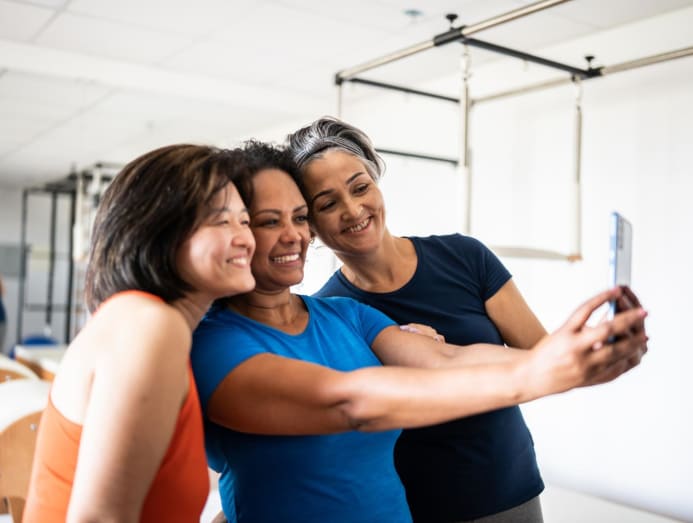
Lim said she may have eased into midlife better if she had a community who was open to share about their personal journeys during this period.
"My advice is to enquire others how they felt and what to wait. It prepares you for what's to come. For me, it was the shock of seeing these physical changes although mentally, I am still the same person."
What saved author Ada Calhoun was solace in her community to, in her words, "Get past whatever way we can". The enquiry for her book was her mode to discover that in her midlife crisis, she wasn't solitary and many women were too sharing like experiences.
The project, she said, gave her clarity and solidarity with her friends. "The realisation that facing upwardly to our lives and seeing information technology as it really is, letting go of by expectations, having a feasible support system and knowing that this phase of midlife doesn't last forever."
Ahead of that, Dr Ng of Better Life said: "Information technology'south important to consistently attend to yourself. Notice what makes you happy, what your passions are and what makes you experience alive. Devote time to doing things which are aligned with the core of your identity."
CNA Women is a new department on CNA Lifestyle that seeks to inform, empower and inspire the modern woman. If you have women-related news, bug and ideas to share with us, e-mail CNAWomen [at] mediacorp.com.sg .
Source: https://cnalifestyle.channelnewsasia.com/women/women-midlife-crisis-signs-menopause-ageing-300156
0 Response to "Midlife crisis in women: What are the signs and how to cope with it"
Post a Comment